



Agriculture has always involved a degree of uncertainty. A farmer must decide what to grow months before harvest, a trader must anticipate market prices, and a warehouse operator must estimate how much produce will arrive during the season. When these decisions rely on incomplete information, the result can be an oversupply of one commodity and a shortage of another.
Artificial intelligence (AI) is helping the agricultural sector approach these decisions differently. By analysing weather patterns, crop acreage, historical prices, market arrivals and consumption trends, AI can help estimate how much agricultural produce will be available, where demand is likely to emerge, and when markets may experience a mismatch.
For an agricultural economy as large and diverse as India, this ability to anticipate market movements could make a meaningful difference.
Why agricultural demand and supply are difficult to predict
Agricultural production depends on several variables that do not always move in the same direction. Rainfall, temperature, soil conditions, pest attacks, and sowing patterns influence how much a farmer eventually harvests. Meanwhile, demand changes with consumer preferences, food processing requirements, exports, government procurement, and commodity prices.
Consider maize as an example. If favourable weather encourages farmers across several regions to increase maize cultivation, production could rise substantially. However, if demand from poultry feed manufacturers, ethanol producers, and other industrial users does not increase at the same pace, market prices may come under pressure. The opposite can happen when unexpected weather damage reduces production while demand remains steady.
These mismatches affect more than prices. They influence procurement planning, storage requirements, working capital, inventory decisions, and the movement of commodities between regions.
According to a NITI Aayog working group report on crop husbandry and agricultural demand and supply, India’s overall food demand could grow by approximately 2.4% annually under a business-as-usual growth scenario, increasing to around 3.1% under a higher-growth scenario. The report also identifies potential supply constraints in categories such as pulses and edible oils. These projections underline why production planning needs to account for changing consumption patterns, not just historical harvests.
How AI in agriculture improves demand forecasting
AI models can process large volumes of historical and real-time information to identify patterns that may be difficult to detect through conventional analysis.
- Predicting crop production before harvest
Satellite imagery, weather forecasts, crop acreage data, and historical yields can help AI models estimate likely production. These estimates can be updated as the crop progresses through different growth stages.
For instance, if satellite observations indicate reduced crop vigour in a major wheat-growing region and weather data suggest prolonged heat stress, the model can flag a possible production shortfall. Procurement teams can then reassess expected arrivals and sourcing plans.
India is already building capabilities in this area. In August 2026, the Ministry of Agriculture reported that the FASAL programme uses multispectral and synthetic aperture radar satellite data to forecast production for 11 major crops across 20 states. AI can complement such information by combining crop estimates with market and consumption signals.
- Estimating demand across markets
AI can analyse historical consumption, mandi arrivals, price movements, industrial buying patterns and export trends to estimate demand for different commodities.
A processor planning its next quarter’s procurement, for example, could use these insights to estimate how much maize or soybeans it may need and which sourcing regions are likely to offer adequate supply. Such forecasts can help businesses avoid last-minute purchasing, reduce uncertainty, and plan inventory more effectively.
- Anticipating price movements
Prices reflect the relationship between expected availability and demand. AI models can examine historical price behaviour alongside current crop conditions, market arrivals, weather forecasts and external market indicators.
These models cannot guarantee future prices. However, they can identify emerging risks, such as a possible surplus in one region or tighter availability in another, allowing traders and procurement teams to make better-informed decisions.
- Planning storage and procurement
Forecasting becomes more useful when it leads to operational decisions. If a region is expected to produce a large harvest, procurement teams can prepare sourcing networks, warehouse capacity, and inventory plans in advance.
Similarly, a projected shortfall can prompt businesses to explore alternative sourcing locations before competition for available stocks intensifies.

What are the challenges of AI-based agricultural forecasting?
AI is only as reliable as the information and assumptions behind it. Incomplete market-arrival data, inaccurate acreage estimates, sudden policy changes, and unexpected weather events can affect forecast quality.
Agriculture also varies considerably between regions. A model trained on one crop-growing belt may not perform equally well elsewhere without suitable local data.
For this reason, AI forecasts should complement ground-level intelligence, agronomic expertise and market experience rather than replace them. Regularly updated data, transparent assumptions, and human oversight remain essential.
How StarAgri Supports AI-Driven Agricultural Planning
AI can help predict what the market may need, but businesses also need the right infrastructure and data to act on those insights. StarAgri brings together agricultural warehousing, procurement, collateral management, quality testing and supply-chain services to support more informed decisions across the agricultural value chain.
By combining AI-driven insights and predictive analytics with information on crop production, market arrivals, commodity prices and storage availability, agricultural businesses can better anticipate supply fluctuations, plan procurement and manage inventory. Such data-led approaches can help identify potential surpluses or shortages earlier, supporting more timely and informed decisions.
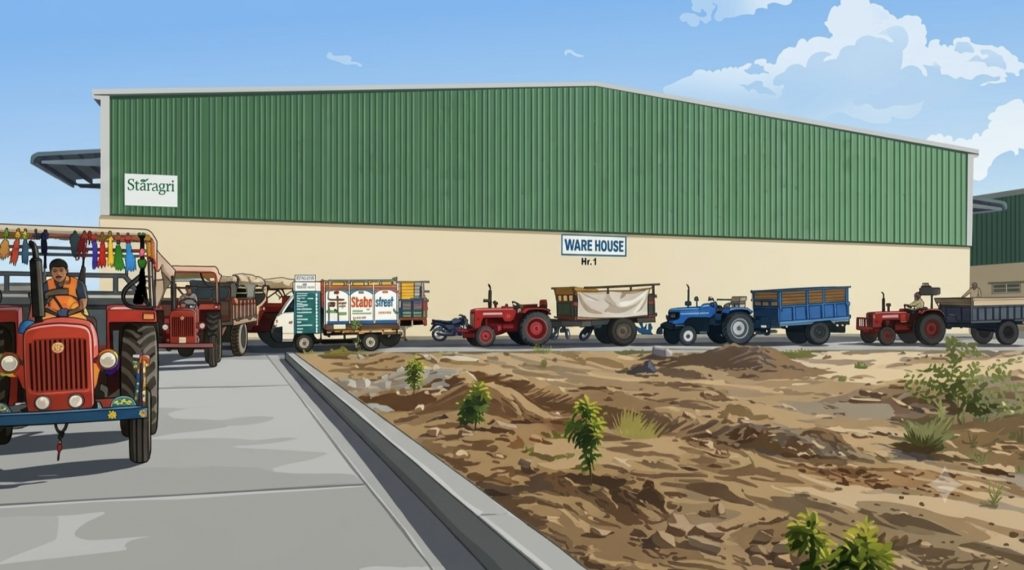
StarAgri’s network of 2,200+ warehouses across 380+ locations in 19 Indian states, with storage capacity exceeding 5 MMT, provides the physical infrastructure to support agricultural commodity management at scale. Alongside procurement services and quality assessment through Star Labs, these capabilities can help businesses translate better market intelligence into more organised storage, sourcing and inventory planning.
The opportunity lies in connecting AI-led forecasting with on-the-ground agricultural expertise and reliable infrastructure. Together, these can help build a more responsive, efficient, and resilient agricultural supply chain.
Conclusion
AI can help predict agricultural demand and supply by bringing crop production estimates, weather information, consumption trends, and market data into a more connected decision-making process. Its greatest value lies not in predicting every market movement perfectly, but in giving farmers, traders, processors and storage operators more time to prepare.
As India’s agricultural data infrastructure develops, combining predictive intelligence with dependable physical infrastructure will be increasingly important for building a more responsive and resilient agricultural value chain.
FAQs
- What is AI in agriculture?
AI in agriculture uses machine learning, predictive analytics, satellite imagery, and other data sources to support decisions about crop production, farm management, market demand, and agricultural trade.
- Can AI predict agricultural prices?
AI can estimate price trends by analysing historical prices, market arrivals, weather, production forecasts and demand indicators. Predictions remain uncertain and cannot guarantee future prices.
- How does AI help predict crop production?
It analyses crop acreage, satellite imagery, weather conditions, vegetation indicators and historical yields to estimate potential production before harvest.
- Can AI help prevent agricultural oversupply?
AI can flag potential production surpluses by comparing estimated output with expected demand. Farmers and procurement businesses can use these insights to review crop plans, sourcing strategies and storage requirements.
- How does StarAgri support agricultural supply chains?
StarAgri provides warehousing, procurement, collateral management, quality testing, and related agricultural services that support commodity storage, handling, and trade.
